Dunoon fire: The largest informal settlement blaze in a decade leaves thousands homeless

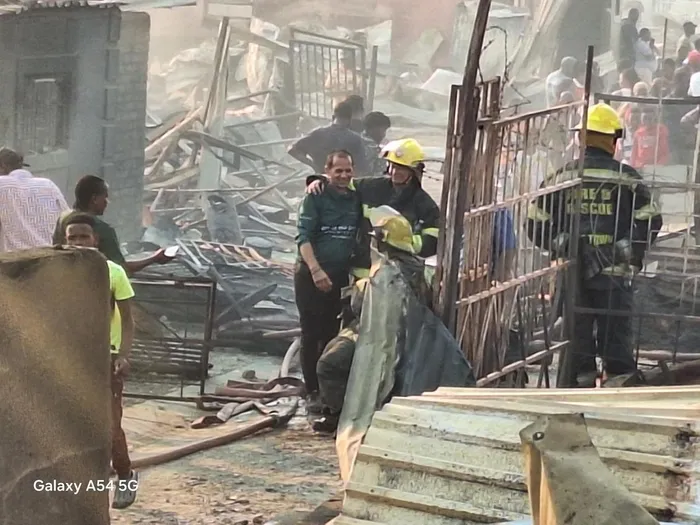
Firefighters assist residents through the wreckage after a devastating blaze tore through Site 5 in Dunoon, destroying hundreds of homes and displacing thousands.
Image: Supplied
The fire that tore through Site 5 in Dunoon is believed to be the largest informal settlement blaze in the Western Cape since the Khayelitsha fire of 2013, according to Imtiaz Sooliman, founder of Gift of the Givers, as thousands of residents remain displaced and emergency relief continues.
More than 1 000 dwellings were completely destroyed when the fast-moving fire swept through the settlement on Friday, leaving an estimated 5 500 people homeless. Strong winds fuelled the blaze, forcing firefighters to deploy two helicopters for aerial water-bombing before it was extinguished at about 7pm.
Sooliman said the scale of destruction was overwhelming.
“This is probably the largest informal settlement fire in the WC since the Khayelitsha fire of 2013,” he said.
“In excess of 1 000 dwellings were totally obliterated. Alas 5 500 of our fellow compatriots became refugees in their own space,” Sooliman said.
Disaster Risk Management Centre spokesperson Charlotte Powell said the registration of affected residents was underway, but cautioned that the full extent of the damage was still being assessed.
“Given the scale of the incident, it will take some time to determine the number of structures destroyed and persons affected,” Powell said.
She confirmed that operations were being coordinated through a mobile Joint Operations Centre and that a building inspector had been deployed to assess the safety of nearby formal dwellings.
Sooliman said the organisation fed 3 000 displaced residents and 220 emergency workers on Friday night, followed by breakfast for 3 500 people on Saturday morning.
Cape Town Mayor Geordin Hill-Lewis praised the efforts of emergency crews and City staff.
“This was a terrible fire, which our firefighters bravely fought to get under control in difficult, windy conditions which also required aerial water-bombing using two helicopters,” Hill-Lewis said.
Animal welfare teams have also been deployed. The Cape of Good Hope SPCA confirmed it had activated a large-scale disaster response in Dunoon.
SPCA spokesperson Belinda Abraham said animals were often overlooked during disasters.
“When disasters of this scale occur, animals are often hidden casualties,” Abraham said.
CapeNature also urged the public to act responsibly and lawfully when encountering wildlife affected by fires.
"We remind members of the public that our unique fynbos ecosystem is adapted to fire, and it is a natural and necessary ecological process for fynbos,” CapeNature said.
“Without fire, these plants would simply grow old, stop reproducing and die. Even the fynbos dwelling animals have adaptations such as rapid reproduction in the Cape Dwarf Chameleon or Tortoises burrowing deep into the soil when they smell smoke.”
To date the Western Cape has already authorised 38 aerial firefighting missions this season, with approximately 90 000 hectares burnt by the recent fires.
It said according to the Provincial Disaster Management Centre, R15 million has already been spent on aerial firefighting support, with further funding being considered as hot and dry conditions are expected to persist beyond March.
“Although animals may appear injured or disoriented, many can move away and recover without intervention. Unnecessary handling can cause severe stress, injury or death, and may place people and wildlife at risk,” CapeNature stressed.
“Importantly, only trained and authorised individuals and/or facilities are permitted to handle, transport or rehabilitate wild animals, in line with environmental legislation and that have the required permit/s is in place."
Get your news on the go, click here to join the Cape Argus News WhatsApp channel.
Cape Argus