Facing the music: Ramaphosa's challenge in delivering on promises
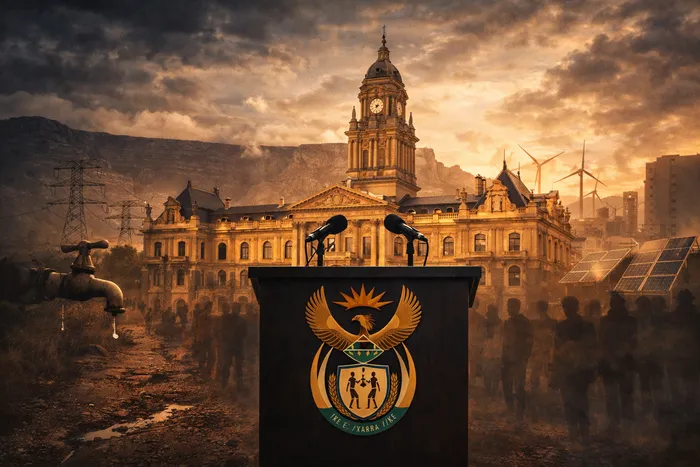
SONA 2026 looms as a defining test of credibility, delivery and public trust.
Image: AI Generated
South Africans are weary of promises and want a tangible delivery as President Cyril Ramaphosa’s State of the Nation Address (SONA), approaches on Thursday.
The address comes at a moment of deep voter cynicism ahead of local government elections, amid persistent service-delivery failures, corruption concerns and mounting pressure for economic reforms that translate growth into lived improvements.
Political analyst Amanda Gouws said the President is expected to emphasise unity within the Government of National Unity (GNU), formed after the 2024 national election, and attempt to persuade voters that coalition governance can work, particularly at local level.
“I think he may talk about unity in the GNU and attempt to convince voters that all the parties are working together for a prosperous South Africa,” Gouws said. “This is to make a case that coalitions on a local level can work.
“Most constituencies, whether men, women or jobless people are tired of empty promises and very cynical about politics. Most distrust government, so President Ramaphosa will have to pull a rabbit out of a hat for this not to be viewed as business as usual,” she said.
With municipal elections approaching, Gouws said Ramaphosa would also face pressure to address service-delivery failures at local government level, including water shortages, electricity disruptions and deteriorating road infrastructure.
“Women are the worst hit by bad service delivery, especially at local government level, because they suffer disproportionately when there is no water or electricity,” Gouws said.
In communities experiencing high levels of violent crime, she added, residents are demanding clarity on what government is doing to improve safety, particularly where children are caught in gang crossfire.
Gouws said the ANC has, in the eyes of many voters, become associated with poor service delivery and corruption, adding that repeated unfulfilled commitments made during successive SONAs have fuelled public cynicism.
Economist Frank Blackmore said he expects the President to highlight recent economic gains while reinforcing policy continuity rather than introducing radical shifts.
Blackmore said Ramaphosa is likely to point to fiscal consolidation, a reduced inflation target, a sovereign credit rating upgrade and improved growth prospects as indicators of stabilisation.
“I don’t think we’ll see too many radical ideas such as nationalisation of banks or the NHI, because at this point we simply don’t have the physical capacity for such ideas,” Blackmore said.
Instead, he expects renewed emphasis on infrastructure investment, logistics reform and energy stabilisation, particularly where private-sector participation is already under way.
“These are the areas holding us back in terms of growth,” he said, adding that the SONA is likely to set the tone for a budget that continues prioritising consolidation and growth alongside the social wage and job creation.
The City's Mayco Member for Economic Growth and Tourism, James Vos, issued an open letter calling on the President to announce the implementation of an Open Skies policy.
Vos described the reform as one of the fastest ways to stimulate economic growth, lower airfares and unlock tourism, trade and investment.
The GOOD Party has outlined four priorities it wants the President to address, spanning education, economic growth, criminal justice and housing.
GOOD Secretary-General Brett Herron criticised persistent inequalities in basic education, and warned that the R370 Social Relief of Distress grant remains inadequate when measured against what he said was a food poverty line of R855 a month.
Herron also called for a fundamental rethink of the state’s housing delivery model, arguing that the current approach is incapable of delivering homes at the scale required.
Get your news on the go, click here to join the Cape Argus News WhatsApp channel.
Cape Argus