Are South Africans the world's most time-strapped commuters?

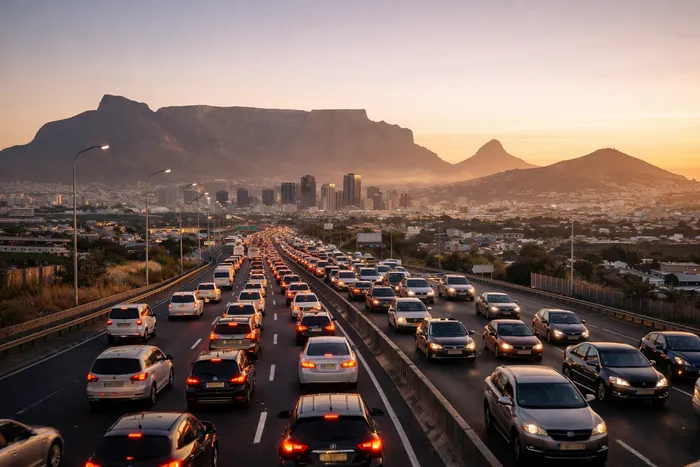
Morning traffic builds along the N1 as commuters head into Cape Town’s CBD, highlighting the city’s daily congestion.
Image: AI Generated
Cape Town commuters who feel like they spend half their lives on the road may not be exaggerating.
A new global study by the UK automotive marketplace Autotrader found that South African drivers spend more time commuting by car than motorists anywhere else in the world, clocking up the equivalent of 10 days, four hours and 48 minutes a year travelling to and from work.
The study used survey responses from motorists about their daily commuting time and combined these with working patterns, public holidays and annual leave to estimate annual driving commute times.
South Africa topped the global ranking, followed closely by India, where motorists spend about 10 days and nearly two hours commuting annually, and Ireland, where drivers spend roughly nine days and 14 hours travelling to and from work each year.
Globally, drivers spend an average of eight days, five hours and 53 minutes a year commuting by car.
Despite the time spent behind the wheel, the Autotrader study found that many South African motorists do not necessarily view the daily drive as a negative experience.
In fact, 72% of South African drivers said they find their commute relaxing, one of the highest levels recorded among the countries surveyed.
The research suggests many commuters use the time for personal entertainment or quiet reflection. About 82% listen to music, podcasts or audiobooks during their commute, while 47% say they value the time alone and 32% say they enjoy the act of driving.
However, traffic congestion remains the biggest frustration for commuters globally.
According to the study, 84% of drivers say traffic is the most frustrating part of their commute, a figure that rises to 92% among South African motorists.
For Cape Town commuters, those frustrations play out in a city already grappling with severe congestion, according to separate traffic data.
The 2025 INRIX Global Traffic Scorecard ranked Cape Town sixth in the world for traffic delay, with the average driver losing 96 hours a year in peak congestion, roughly the equivalent of four full days spent sitting in traffic.
Morning queues on the N1, N2 and M5 regularly stretch for kilometres as thousands of commuters head towards the CBD and surrounding employment hubs.
Only Istanbul, Chicago, Mexico City, New York City and Philadelphia recorded higher annual delays.
The ranking places Cape Town among the 10 most congested cities globally, and well ahead of other South African metros. Drivers in Johannesburg lose about 59 hours a year in congestion, compared with 48 hours in Pretoria, 33 hours in Durban and 30 hours in Gqeberha.
Vehicle reliability also emerged as a major challenge in the Autotrader study. The research found that 84% of South African drivers experienced a car fault in the past year that affected their commute, the highest proportion among the countries surveyed.
Even so, many drivers say the time spent in the car is not entirely wasted. The study found that 94% of South African motorists reported feeling productive during their commute, the highest level globally.
Productivity expert Emily Austen said commuting time can still serve a useful purpose, even when drivers are not technically working.
“One of the biggest misconceptions about productivity is that it only counts if you’re visibly producing something,” Austen said.
“Productivity on your commute doesn't mean working, in fact the 82% of people who spend their commute time listening to music, podcasts and audiobooks are being productive already.”
For many Cape Town commuters, the daily drive may involve long lines of brake lights and slow-moving traffic. But it has also become something else, a rare pocket of uninterrupted time between home and work.