Three spotted gully sharks released back into the ocean in Eastern Cape

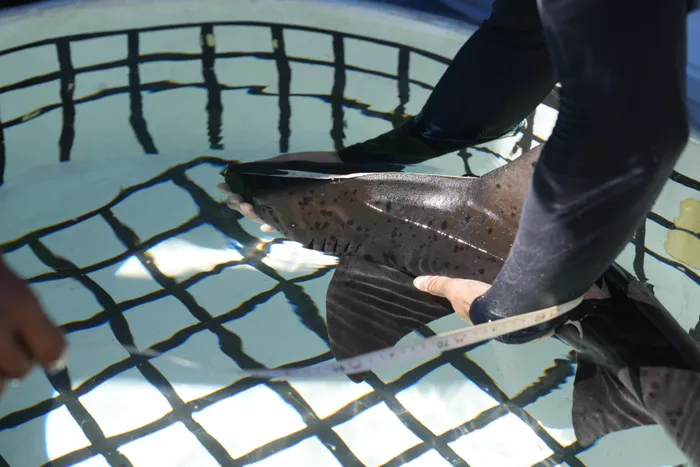
Members of the Two Oceans Aquarium’s curatorial and veterinary teams assess one of the spotted gully sharks in preparation for its release back into the wild.
Image: Supplied
Three spotted gully sharks that had outgrown their home at the Two Oceans Aquarium have been released back into the ocean in the Eastern Cape as part of a research effort to better understand shark movements along the southern African coastline.
The sharks, one female and two males, were released at Mgwalana near East London after spending several years in the Aquarium’s Kelp Forest Exhibit.
According to the Aquarium, the animals were originally collected off East London, two in 2022 and one in 2023, and were returned to the same stretch of coastline where they were first found.
Senior aquarist Simon Brill said releasing sharks when they outgrow the exhibit or reach sexual maturity is standard practice.
“Releasing sharks once they outgrow the exhibit or reach sexual maturity is standard practice for us,” Brill said. “All three of these spotted gully sharks were originally collected in East London, two in 2022 and one in 2023, so we were fortunate to return them to the same coastline where they were first found.”
In preparation for their return to the wild, the sharks were removed from the exhibit in November 2025 and temporarily housed in a large holding pool while undergoing health checks.
The Aquarium’s veterinary and curatorial teams, led by Ilse Jenkinson, conducted blood tests, physical examinations and measurements to ensure the animals were fit for release.
During the assessments, each shark was fitted with two research tags designed to help scientists track their movements and growth.
A VEMCO acoustic tag was surgically inserted beneath the skin of each shark, while an external spaghetti tag was attached below the dorsal fin. The acoustic tags can transmit signals for up to 10 years and can be detected by underwater receivers positioned along the southern African coastline.
When a tagged shark passes within range of one of these receivers, the system records the animal’s unique signal, allowing researchers to track its movements over time.
The spaghetti tags serve a complementary purpose by encouraging participation from the fishing community. Each tag carries a unique identification number and contact details so that anglers who catch a tagged shark can report where and when it was caught, as well as its size.
These reports help scientists gather information on growth rates and movement patterns.
Once veterinary checks were completed, the sharks were transported to Mgwalana and released into the ocean after a short acclimatisation period.
“The release went very well,” Brill said. “After a short acclimation to the sea temperature, the sharks were released into calm, warm water. All three sharks swam off strongly.”
Spotted gully sharks (Triakis megalopterus) are endemic to the southern African coastline, ranging from Walvis Bay in Namibia to Coffee Bay in the Eastern Cape.
Although commonly encountered in coastal waters, the species is considered vulnerable to overfishing because it grows slowly, produces relatively few young and spends much of its life in shallow waters over sandy and rocky seabeds.
The Aquarium said data collected from the tagged sharks will help researchers better understand how the species moves along the coast, how quickly individuals grow and which habitats are most important to their survival.
By releasing the animals while they are still relatively young and nearing sexual maturity, the Aquarium hopes they will contribute to future generations of spotted gully sharks in the wild.