How Dr Anneke Erasmus is changing climate science


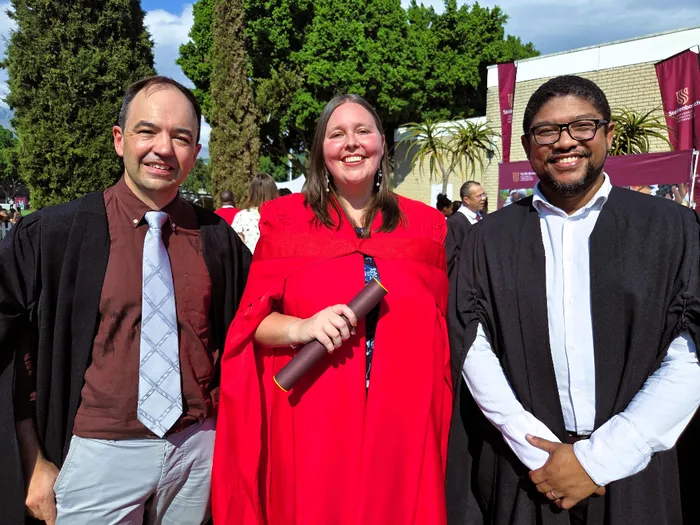
Dr Anneke Erasmus, an alumnus of Brackenfell High School, was one of six female scientists to earn their doctoral degrees in Physics during Stellenbosch University’s March graduation ceremony. Here she is with her study leader, Prof. Pieter Neethling, and co-supervisor, Dr Gurthwin Bosman, from the Department of Physics.
Image: Supplied
A Stellenbosch University physicist who once lingered after lectures to ask about lasers has turned that early curiosity into cutting-edge climate research, despite battling loadshedding, a flooded laboratory and months of disruption.
Dr Anneke Erasmus is among six women who graduated with a PhD in Physics during the university’s March graduation ceremonies this week, part of a record cohort that underscores growing momentum for women in science.
Her research centres on optical trapping, a technique that uses lasers to hold microscopic particles in place, enabling scientists to study individual droplets with extreme precision. The work contributes to improving understanding of aerosol dynamics, a key factor in climate models and predicting future environmental change.
But the path to her breakthrough was far from smooth.
While conducting experiments in the Merensky building at Stellenbosch University, Erasmus faced repeated interruptions from loadshedding, which disrupted highly sensitive measurements that often ran for more than an hour at a time. In 2021, her research was set back by several months after a burst water pipe flooded the laboratory.
“The water was streaming down from the ceiling and walls of our lab,” Erasmus said. She had to dismantle the entire setup, clean and inspect each instrument for damage, and rebuild the system from scratch.
Further challenges followed in 2024 when vibrations from renovation work in the building interfered with measurements to such an extent that she was forced to conduct experiments after hours.
Despite these setbacks, Erasmus, an alumna of Brackenfell High School, designed and built the entire experimental setup herself. She was the only postgraduate student working on the project, supported by a small supervisory team.
“Together with my supervisors, we were a small team tackling this question, how to use light to more accurately measure the physical properties of individual droplets,” she said.
Her work focused on whether light could be used to measure the physical properties of individual droplets more accurately. Using a counter-propagating optical trap, with two lasers directed at each other, she was able to trap a microscopic saltwater droplet and suspend it in midair for up to five hours.
By making small adjustments to the laser power, Erasmus induced cycles of evaporation and condensation in the droplet. These changes were measured indirectly by analysing how light scattered off the droplet, a method known as Mie scattering.
The technique allowed her to measure the droplet’s size with an uncertainty of only a few nanometres, significantly more precise than conventional optical methods.
Because the system is highly dynamic and sensitive to external disturbances, each measurement required sustained stability, adding to the complexity of the research.
Professor Pieter Neethling, head of the Stellenbosch Photonics Institute and Erasmus’s study leader, said the work marks what they believe is a first in tracking such minute changes in droplet size in real time as temperature changes.
“Measuring these dynamics in a controlled laboratory environment contributes to our understanding of droplet formation in the atmosphere and the interplay between atmospheric temperature and droplet size, which has great significance in our understanding of cloud formation, and hence the climate,” he said.
Erasmus’s academic journey began as an undergraduate student intrigued by laser physics, often staying behind after lectures to ask questions and observe experimental setups in the department’s laboratories.
That curiosity later took her to leading international research institutions, including the Rutherford Appleton Laboratory in the United Kingdom, the University of Bern in Switzerland and Durham University in the United Kingdom, where she was exposed to advanced photonics and laser-based experimental systems.
Her achievement forms part of a broader milestone for Stellenbosch University’s Faculty of Science, which produced a record 72 PhD graduates in 2025, up from 47 in 2024, a 51% increase. Of these, 55.6% are women, graduating across fields including Physics, Chemistry and Polymer Science, Mathematics and Computer Science.
Dean of the Faculty of Science, Professor Bertie Fielding, said the figures reflect strong growth and transformation in the sciences.
“Producing 72 PhD graduates, with more than half of them women, is very encouraging, especially in disciplines where women have historically been underrepresented,” he said.
For Erasmus, the journey from curiosity to completion has been defined by persistence as much as precision, with her work now contributing to a deeper understanding of the microscopic processes that shape the planet’s climate.