Judicial Service Commission's ruling on Mbenenge's misconduct sets stage for impeachment


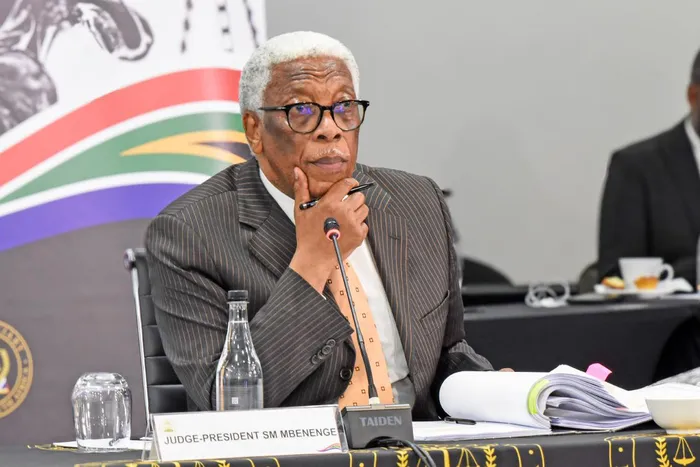
Judge President Selby Mbenenge has been found guilty of gross misconduct by the Judicial Service Commission following a complaint by Andiswa Mengo.
Image: Office of the Chief Justice/ S Lioners
The Judicial Service Commission (JSC) has put Eastern Cape Judge President Selby Mbenenge on the path to potential removal after overturning its tribunal's findings and finding him guilty of gross misconduct.
In a decision last Thursday with far-reaching implications, the JSC rejected the tribunal’s earlier finding that Mbenenge was not guilty of sexual harassment, instead concluding that his conduct, when properly assessed in context, meets the threshold for impeachment under section 177 of the Constitution.
The tribunal had found that Mbenenge engaged in a "flirtatious" WhatsApp relationship with court secretary Andiswa Mengo, but ruled that the exchanges were not unwelcome and therefore did not constitute sexual harassment.
It instead found him guilty of misconduct.
The JSC has now sharply departed from that conclusion, finding that the tribunal "misdirected" itself by focusing too narrowly on whether the exchanges took place during working hours, instead of interrogating "their nature, content and context" and the power imbalance between the parties.
It also rejected the tribunal’s approach to sexual harassment, finding that it failed to apply the correct legal test and did not adequately consider the disparity in power between a judge president and a junior staff member.
On the admitted facts, the JSC concluded that Mbenenge’s conduct, including the sexual nature of the communications, his position of authority, and his lack of remorse, was "grossly inappropriate" and incompatible with the standards expected of judicial office.
The commission ultimately found him guilty of gross misconduct.
Mbekezeli Benjamin, research and advocacy officer at Judges Matter, said the decision triggers the next phase of accountability.
"In terms of section 177 of the Constitution, a gross misconduct finding by the JSC and a referral to the Speaker of the National Assembly initiates the impeachment process, which may ultimately result in the removal of the judge from office," he said.
He added that the JSC has confirmed it will refer the matter to Parliament, meaning "the initiation of impeachment".
Once tabled, the matter will be referred to Parliament’s Justice Portfolio Committee, which will consider submissions from Mbenenge, assess the tribunal report and the JSC’s findings, and make a recommendation. A two-thirds majority in the National Assembly would be required to remove him from office.
The Women’s Legal Centre said the decision reinforces established legal principles on sexual harassment, particularly in the workplace.
"Their decision therefore affirms what our law and courts have already found, that sexual harassment is not about flirting or sexual attraction, but it's a form of discrimination that arises because of power," it said.
It added that "sexual harassment is about one person exerting their power over another person in the workplace", and that judges carry heightened responsibility given their authority.