Associate nations have shown they can run with the big dogs and lift their leg at the T20 World Cup
SHARP TURN


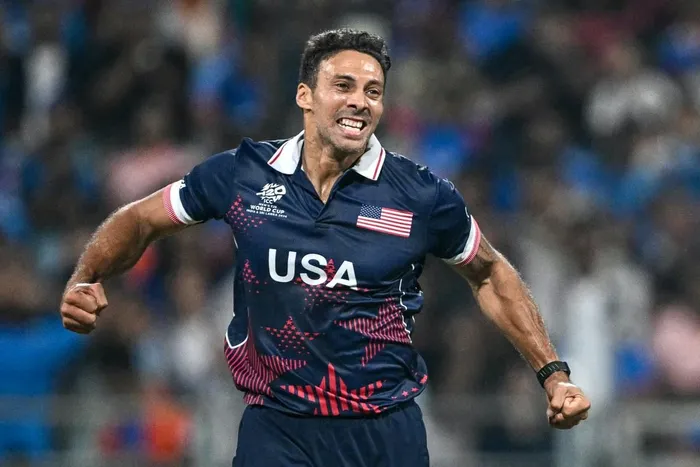
South African-born allrounder Shadley van Schalkwyk nearly led the USA to a historic victory over India at the T20 World Cup.
Image: Punit PARANJPE / AFP
It's become almost customary to switch on the television and tune into T20 cricket being played somewhere in the world.
Be it the IPL, Betway SA20, Big Bash, CPL, PSL, T20 Blast, ILT20, MLC, GLT20, The Hundred, BPL or Nepal T20 League, there will be someone bowling slower balls and cutters trying to deceive a batter aiming to smash the ball out of the ground.
It would be fair to suggest that the avalanche of T20 cricket has made it addictive. Fans want it as much as they crave sugar.
So, when the ICC decided to schedule three matches a day during the group stages of the on-going T20 World Cup, it was manna from heaven. Cricket on telly virtually 12 hours a day.
I had my own selfish reasons for being excited about the expanded fixture list though. 10 years ago, when the T20 World Cup was held in self-same India, eight teams featured in the two preliminary groups, from which two qualified for the Super 10s where the likes of England, Australia, South Africa, Pakistan, India, etc lay in wait.
It was a virtual warm-up before the actual main event. Now call me old-fashioned, but no World Cup - in any format - should consist of preliminaries. That’s what qualifier events are for.
Either you are good enough to run with the big dogs and lift your leg - as former Springbok coach Peter de Villiers said - or you stay at home.
This T20 World Cup has shown that cricket has finally been willing to take the quantitative leap of broadening its participants outside of its traditional powerhouses.
While some may argue that the majority of the Associate Nations still consist primarily of subcontinent expats and a smattering of South Africans, but the platform of playing in a World Cup against a major nation has unlimited potential.
The fact that a country such as Italy faced England was enormous, especially with its traditional sport of football not having featured in a Fifa World Cup for a number of years now. The amount of publicity and interest it created back home can only be beneficial to the game.
Furthermore, the Associate Nations were by no means easy meat. Nepal pushed England to the brink, Canada provided a sensational century by a teenager, the US still boast a bowler atop of the wicket-takers charts and Zimbabwe have captivated audiences across the world with their shock victories over both former champions Australia and Sri Lanka.
The African nation’s story is one of true redemption having missed out entirely when the last T20 World Cup was held in the US and Caribbean two years ago. Their participation in the Super Eights is a fairytale like few others.
Although Afghanistan, who were first-time semi-finalists two years ago, failed to progress to the Super Eights this time around by the barest of margins, they remain the primary example of what can be achieved if sufficient opportunity is provided.
In a cricketing world that already resides in a place of ‘haves’ and ‘have nots’, where discussion continues around shrinking the Test teams circle, and is constantly politicised by the super powers, it has been refreshing to see the ICC at least attempt to market cricket as a truly global sport at this T20 World Cup.
They now have a responsibility to follow it up with funding, infrastructure and regular fixtures to sustain the momentum.