Champions League return confirmed: Is Michael Carrick finally the permanent Man United solution?
On the ball


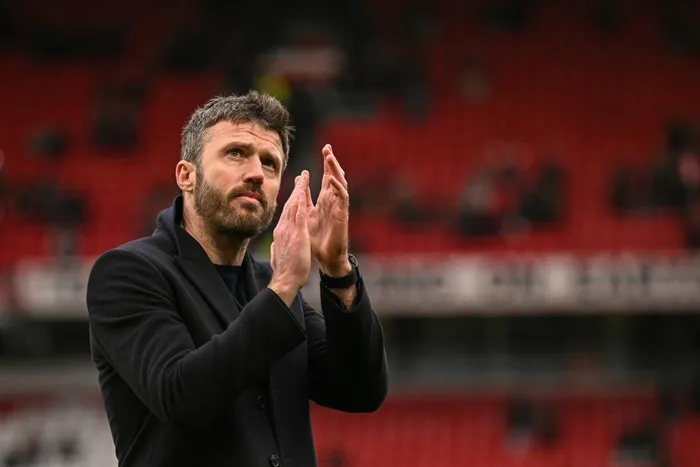
Michael Carrick has worked wonders as interim boss, but the question remains: when will the board make it permanent? Photo: AFP
Image: AFP
COMMENT
At most clubs, a win over Liverpool that secures Uefa Champions League football would trigger a fairly predictable sequence: celebration, clarity, and at least some sense of direction for the future. At Manchester United, however, it appears to have triggered something closer to a group meeting that ends with everyone agreeing to “circle back next week”.
Because even after Sunday’s result – the kind that usually settles arguments rather than extends them – the question hanging over Old Trafford is still the same: why has Michael Carrick not been offered the job full-time yet?
Carrick has steadied the ship and done most of the difficult work already. The team looks more organised, the results have improved, and the season has been rescued from what, at various points, felt like it was drift into the chaos of last season. In most football ecosystems, that combination tends to earn at least a conversation about permanence.
Chelsea, for one, would bite your hand off if offered the chance to be in the same position right now (but that's a story for another day). Not necessarily at United, though. At this club, even momentum seems to arrive with paperwork still pending. If they were South African there'd probably be a commission of inquiry thrown in for good measure.
The irony, of course, is that the timing could hardly be more straightforward. A win over Liverpool to secure Champions League qualification is usually the kind of moment that sharpens decision-making rather than softens it. Instead, it has only added another layer to the familiar Old Trafford habit: the art of not quite committing to anything too quickly.
Part of the hesitation may be understandable. United have spent the past decade reacting rather than planning, and there is an obvious desire not to rush into another long-term appointment based on short-term uplift. Ruben Amorim's disastrous spell may also have dulled the club's appetite for rushing into managerial appointments.
But there is a difference between caution and paralysis, and supporters have become well-versed in spotting the gap between the two.
What makes the Carrick situation particularly curious is that it doesn’t feel like a traditional managerial debate. It feels more like a club trying to decide whether to formally acknowledge something that is already working in practice. The players have responded, the performances have stabilised, and the results – crucially – have followed. Yet, the official stamp of approval is still missing.
And so the familiar United pattern emerges again: a promising direction, a positive outcome, and then … a pause long enough for everyone to start wondering what the actual plan is.
To be fair, there is always an argument for due diligence. But there is also a point at which due diligence starts to look like delay dressed up as process. Carrick may not need a lifetime contract, but he probably deserves more than a holding pattern after delivering exactly what the season required.
Elsewhere in the league, decisions are rarely this complicated. At United, even a successful run-in somehow becomes another internal review.
Perhaps the most telling detail is not that the job hasn’t been offered yet, but that nobody seems entirely surprised that it hasn’t. That, more than anything, says a lot about where the club finds itself: still capable of big wins, still uncertain about what to do after them.
For now, the football has done its part. The question is whether the decision-makers are ready to do theirs, or whether this is just another case of Manchester United turning clarity into a conversation that lasts a little longer than it needs to.